
UK Budget 2026: What It Means for Scottish Businesses
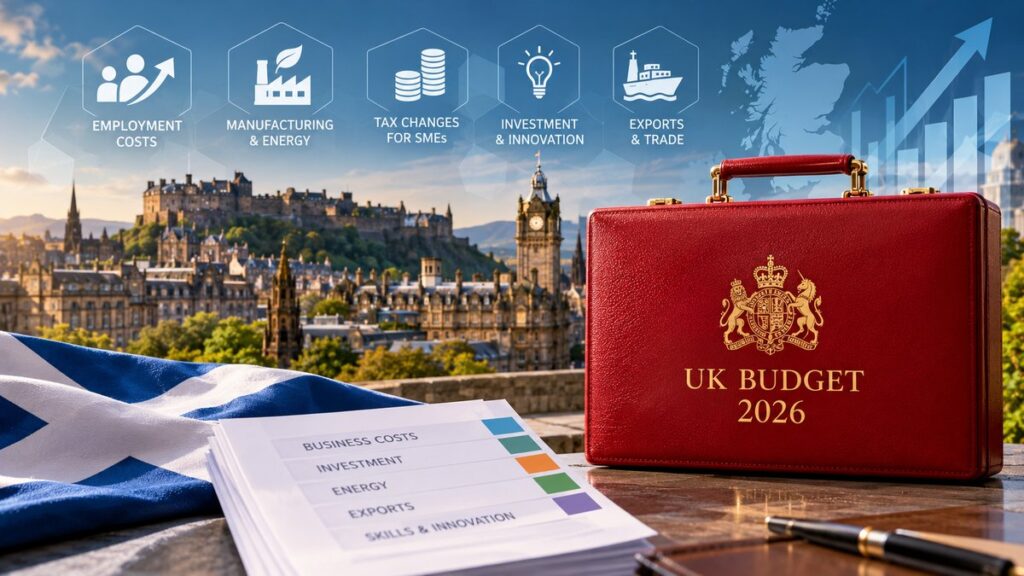
The UK Budget 2026 brings higher wage costs for Scottish employers alongside new energy support, investment funding and tax changes for small businesses.
Chancellor John Healey delivered the Budget on 28 October, announcing measures covering business taxation, fuel costs, manufacturing, entrepreneurship and investment.
The Scottish Chambers of Commerce welcomed some of the investment commitments but warned that the Budget had failed to provide the reassurance employers were seeking over the cost of doing business.
Manufacturers may qualify for electricity bill discounts, while hospitality and retail businesses face higher wage costs from April 2027.
Some important decisions, particularly on business rates, will not become clear until the Scottish Government delivers its own Budget on 3 December.
UK Budget 2026: Key changes for Scottish businesses
| Measure | What is changing |
|---|---|
| National Living Wage | Rises 3.9% to £13.21 an hour from April 2027 |
| Employer National Insurance | Remains at 15%, with no new general employer relief |
| Industrial electricity | Eligible manufacturers could receive discounts of up to 25% |
| Fuel duty | Existing 5p reduction extended until 30 June 2027 |
| Trading allowance | Increases from £1,000 to £3,000 in April 2027 |
| Business mileage | 55p per mile for the first 10,000 miles from April 2026; 35p thereafter from April 2027 |
| Founders’ Relief | New 10% Capital Gains Tax rate for qualifying founders |
| Scottish investment | Funding for Edinburgh technology, Glasgow events and defence skills |
Higher wages add to Scottish employers’ costs
The National Living Wage will rise by 3.9% to £13.21 per hour from 1 April 2027, while the minimum wage for 18 to 20-year-olds increases to £11.27.
Workers aged 16 and 17, along with eligible apprentices, will receive a minimum of £8.31 per hour.
The increases will benefit lower-paid employees but also add to payroll costs for businesses employing staff on minimum wage rates.
Employer National Insurance remains at 15%, with the Employment Allowance unchanged at £10,500.
That combination is particularly relevant to Scottish hospitality, retail, care and other labour-intensive sectors, where staffing represents a substantial operating expense.
The Scottish Chambers of Commerce said the Budget had not done enough to address these pressures.
Chief Executive Charandeep Singh highlighted the continued cost of employment as one of several areas where businesses had hoped for additional relief.
Electricity discounts could support Scottish manufacturing
One of the Budget’s more significant measures for industry is the British Industrial Competitiveness Scheme.
From April 2027, more than 10,000 eligible manufacturing businesses across Great Britain could receive electricity bill reductions of up to 25%.
The scheme will remove certain policy costs from eligible electricity bills, with additional payments intended to reflect support during 2026-27.
Scotland’s manufacturing, chemicals, food processing and life sciences sectors could benefit, although individual businesses will need to meet the eligibility requirements.
Energy costs have already been a major concern for Scottish industry.
In October, ScottishBusiness.com reported that Syngenta was considering closing its Grangemouth manufacturing site, putting 377 jobs at risk. The company identified high operating costs and international competition among its difficulties.
The scheme could reduce electricity costs for eligible manufacturers, but businesses will still face other pressures, including wages, transport and raw materials.
Funding announced for Edinburgh, Glasgow and Scottish defence skills
The UK Government also announced several Scotland-specific investment commitments.
These include:
- £18 million for a UK Advanced Chip Design Academy led by the University of Edinburgh.
- £6 million towards expanding Glasgow’s Scottish Event Campus, subject to a business case.
- £20 million for two Defence Technical Excellence Colleges in eastern and western Scotland.
- A £2 billion Energy Wealth Fund within the National Wealth Fund, supporting renewable and low-carbon energy infrastructure across the UK.
The Edinburgh investment could help strengthen Scotland’s semiconductor industry, while the Glasgow funding is intended to expand capacity for major events and exhibitions.
The UK Government also announced additional support for business investment and access to finance through the British Business Bank.
The expanded British Business Bank funding is intended to increase access to finance for start-ups and growing companies, including those in Scotland.
Recent investment activity has already highlighted Scotland’s strengths in advanced manufacturing and technology, including RoslinCT’s £7.25 million Scottish Enterprise grant to support the digital transformation of its cell therapy manufacturing operations.
Smaller tax changes that Scottish businesses should know about
Beyond the headline announcements, the Budget contains several changes relevant to sole traders, contractors and company owners.
Most of these measures concern UK-wide taxes, although Scottish Income Tax rates and bands on non-savings, non-dividend income are set separately by the Scottish Parliament.
Trading allowance increases to £3,000
The annual trading allowance will increase from £1,000 to £3,000 on 6 April 2027.
This will allow individuals to receive up to £3,000 in qualifying trading or miscellaneous income without paying Income Tax on that income.
The change could benefit people running small businesses alongside other employment, as well as freelancers and those testing a new business idea.
The allowance concerns qualifying income rather than profit, and businesses with larger expenses may still prefer to claim actual allowable costs.
Higher mileage rates for business travel
The Government is making the 55p-per-mile rate for the first 10,000 business miles permanent.
From 6 April 2027, the rate for mileage above 10,000 miles will increase from 25p to 35p.
The change could be particularly useful for rural Scottish businesses, tradespeople, contractors and self-employed workers who regularly travel significant distances.
New tax relief for business founders
A new Founders’ Relief will provide a 10% Capital Gains Tax rate on up to £10 million of lifetime gains for qualifying founders of high-growth, innovative companies.
The measure is planned to take effect from 6 April 2027, with eligibility conditions subject to further consultation and legislation.
However, the Budget also reduces the lifetime limit for Business Asset Disposal Relief from £1 million to £500,000.
Owners planning to sell a business will need to check which relief applies, as the new Founders’ Relief and the reduced Business Asset Disposal Relief limit have different eligibility rules.
Other changes on the horizon
The Government will simplify research and development tax relief administration from April 2027, including removing the existing claim notification form.
Businesses will also face mandatory electronic VAT invoicing from April 2029, with the detailed technical requirements due to be confirmed before implementation.
Scotch whisky and North Sea energy remain under pressure
The Budget contains less welcome measures for two established Scottish industries.
Alcohol duty will rise again, prompting criticism from the Scotch whisky industry over the cumulative effect of taxation on producers and consumers.
From 1 February 2027, Small Producer Relief will become more generous for qualifying drinks below 8.5% ABV, including changes to discounts for lower-strength products.
For North Sea oil and gas, the Energy Profits Levy remains in place, with no early end announced.
Scottish Chambers also expressed disappointment that the Acorn carbon capture and storage project in north-east Scotland had not received a confirmed funding commitment.
The concerns come during a difficult period for some Scottish distillers. Earlier this month, GlenWyvis Distillery entered administration after facing financial pressures and unsuccessful efforts to secure further funding.
VAT
Corporation Tax
Fuel duty
Capital Gains Tax
Scottish Income Tax rates and bands on non-savings, non-dividend income
Scottish business rates: What happens next?
One of the most important distinctions for Scottish businesses concerns non-domestic rates.
The Chancellor announced additional rates support for retail, hospitality and leisure properties in England, including an expanded Small Business Rate Relief scheme and a two-year real-terms freeze for other eligible properties.
However, these measures do not automatically apply in Scotland.
Non-domestic rates are devolved, meaning Scottish ministers decide the rates and reliefs applying to business properties north of the border.
The UK Treasury says the Budget provides Scotland with an additional £600 million through the Barnett formula over the Spending Review period. The Scottish Government has disputed the wider funding picture, arguing that its budget faces a real-terms reduction next year. Scottish ministers will decide how devolved funding is allocated.
Business organisations are therefore likely to focus on the Scottish Budget on 3 December, particularly for decisions affecting shops, pubs, restaurants and other high-street premises.
What Scottish businesses should watch next
Eligible manufacturers could see lower electricity bills, while sole traders may benefit from the increased trading allowance. The new Founders’ Relief will apply only to company owners who meet its conditions.
For exporters, the Budget also extends tariff suspensions covering hundreds of products, potentially reducing import costs for businesses using qualifying materials and components.
Scottish companies looking to develop overseas markets can also explore the recently announced £500,000 international trade mission programme, although that programme is funded separately by the Scottish Government.
The next significant date is 3 December 2026, when the Scottish Government is due to set out its own tax, spending and business rates decisions.
Until then, the full implications of the UK Budget for Scottish businesses remain partly unresolved.
Sources
HM Treasury: Budget 2026 | UK Government: Scotland Budget announcement | Scottish Chambers of Commerce: Budget reaction